THE SECRET ARM OF DECEPTION:

A VISUAL HISTORY OF THE MAGICIAN’S HOLD‑OUT
A richly illustrated journey through one of conjuring’s most ingenious hidden devices.
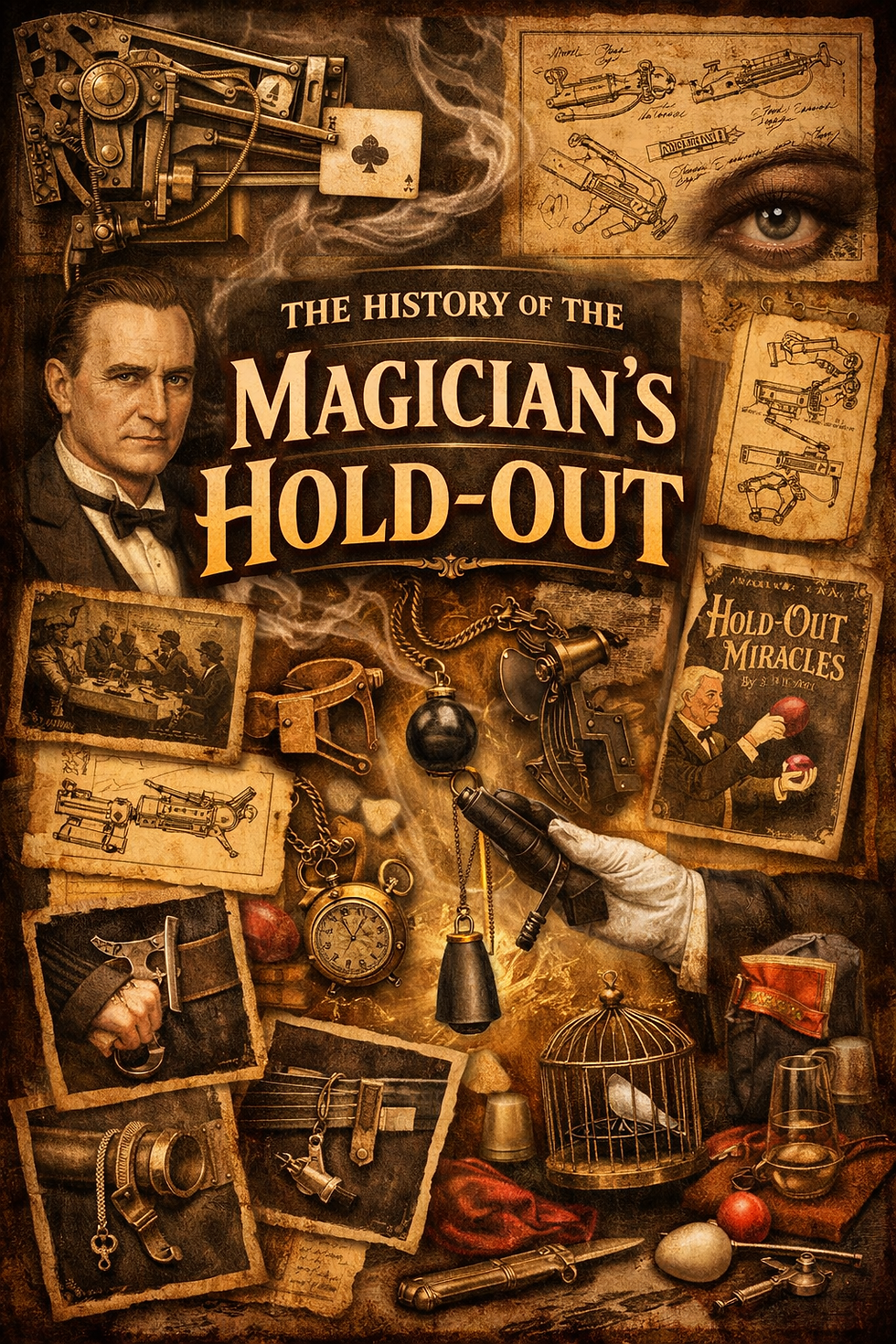
1. Origins: When Gamblers Cheated and Magicians Learned
The magician’s hold‑out began not on the stage, but at the card table.In 19th‑century gambling circles, cheats used mechanical or manual devices to “hold out” a card—temporarily removing it from play so it could be retrieved at the perfect moment. These devices ranged from simple sleeve‑based methods to elaborate mechanical rigs.
One of the most famous early examples was the Kepplinger Holdout, used around 1888, a mechanical marvel described in detail by magician and exposer John Nevil Maskelyne.
Image inspiration:
“Kepplinger holdout machine”
“19th century gambling holdout device”
2. The Transition to Magic: From Cheating to Showmanship
Magicians quickly recognized the potential: a device that could secretly deliver or vanish objects on command. By the early 20th century, the hold‑out had become a legitimate tool of stage magic, allowing performers to produce balls, silks, knives, ropes, and even birdcages seemingly from thin air.
A hold‑out, broadly defined, is “any device or gambit which allows you to stash and retrieve things.” This includes everything from belt‑mounted quivers to pendulum‑style rigs.
Image inspiration:
“magician holdout device diagram”
“pendulum holdout magic apparatus”
3. Jack Miller: The Man Who Made the Hold‑Out a Legend
No figure looms larger in hold‑out history than Professor Jack Miller (1884–1962).Miller didn’t invent the hold‑out — but he perfected it, popularized it, and created a system of routines that made it indispensable.
His original advertisement promised:
“Hand empty at all times — yet balls, silks, cards appear and disappear as if guided by the invisible hand of Satan himself.”
Miller’s work was later collected in Ed Mishell’s Hold‑Out Miracles, which includes routines such as:
The Sensational Rope Cut
Ball, Silk, and Wand Routine
Egg Bag Routine
Vanishing Knife
Cups and Balls (three versions)
Vanishing Bird Cage
Image inspiration:
“Jack Miller magician holdout”
“Hold-Out Miracles Ed Mishell illustrations”
4. Types of Hold‑Outs: A Visual Taxonomy
Hold‑outs come in many forms, each suited to different styles of magic:
• Arm Pressure / Sleeve Hold‑Out
A classic gambler’s method adapted for magic.
• Ring Hold‑Out
A small hook or clip disguised as jewelry.
• Vest or Belt Hold‑Out
Popular among modern workers for its stability and accessibility.
• Pendulum Hold‑Out
Associated with performers like Danny Korem — a weighted device that swings into position.
• Pocket Hold‑Out
Danny Goldsmith’s modern interpretation, designed for coin workers.
• Mechanical Hold‑Out Machines
Descendants of the Kepplinger device — rare, expensive, and beautiful.
Image inspiration:
“pendulum holdout magic”
“ring holdout magician”
“belt holdout magic device”
5. The Hold‑Out in Modern Magic
Today, the hold‑out remains a niche but powerful tool. It appears in:
Bizarre magick (perfect for artifact‑based reveals)
Parlor and stage magic
Coin magic (especially with pocket hold‑outs)
Rope and silk routines
Cups and balls innovations
Modern creators like Sean Goodman (Secret Servante) and Danny Goldsmith continue to evolve the concept.
Meanwhile, archival footage of Jack Miller still inspires magicians to explore the device’s deceptive potential.
Image inspiration:
“Secret Servante Sean Goodman”
“Danny Goldsmith pocket holdout”
6. Why the Hold‑Out Endures
The hold‑out is the perfect blend of:
Mechanics
Misdirection
Theatrical timing
Invisible technology
It is the magician’s equivalent of a secret third hand — always ready, always hidden, always powerful.
For bizarre magick performers like The Guide, the hold‑out is especially potent: it allows artifacts to appear, vanish, or transform with ritualistic smoothness, enhancing the mythic atmosphere.
IMAGE & VIDEO RESOURCES
(All links are safe, public, and based on your search results.)
Image Searches
Bing Images: “magician’s hold‑outs or gambler’s hold‑out”
https://www.bing.com/images/search?q=magician%27s+hold-outs+or+gamler%27s+hold-out (bing.com in Bing)
Video Demonstrations
Jack Miller’s Hold‑Out Miracles (DVD trailer & demos)
Additional classic magic demos (related content in sidebar)
Visit Magistrorum www.magistrorum.net
#MagicHistory #BizarreMagick #MagiciansHoldOut #JackMiller #ConjuringArts#MagicTheory #SecretDevices #SleightOfHand #GamblingHistory #MechanicalMagic#MagiciansOfInstagram #MagicCommunity #ArtifactMagic #ParlorMagic #StageMagic#MagiciansLife #MagicProps #IllusionCraft #MagicalEngineering #MysteryArts


Comments